Honest Review: Hand Holding Rose Line Art Embroidery
I’ve spent years testing and tearing apart machine embroidery design files for boutique sweatshirt collections, and I can usually tell within two seconds whether a design will hold up on fleece or French terry. When I pulled up Hand Holding Rose Line Art Embroidery for a new cozy drop our small shop is planning, my first thought was that the composition hits a sweet spot between romantic minimalism and statement detail that works hard on neutral blanks. This isn’t a generic floral — it’s a hand-drawn gesture with a single bloom, and the line art approach gives it a modern, almost tattoo-like softness that reads intentionally understated.
Right away, the mood registered as soft, feminine, and quietly emotive. The hand and rose silhouette isn’t overly filled; it leans into open paths and clean contours that translate well into thread without choking on heavy stitch density. For anyone curating custom apparel with a boutique feel, this kind of design avoids looking mass-produced because the line weight reminds me of ink work rather than standard clip-art fills. I could picture it stitched in a muted tonal thread on an oatmeal crewneck or in a crisp off-white against washed black hoodies — both would give that handmade, elevated everyday vibe that keeps customers coming back.
First Thread Impression: Mood, Layout, and Stitching Personality
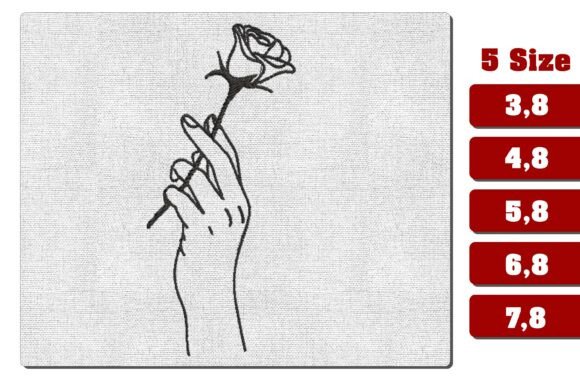
Loading the preview into my software, the layout immediately felt balanced for chest placement. The hand and stem flow diagonally, and the rose lands near the top-right, which gives a natural directional movement. That diagonal axis matters when you’re centering on a unisex sweatshirt because a perfectly symmetrical design can look stiff, while an organic tilt adds effortless cool. Hand Holding Rose Line Art Embroidery has just enough asymmetry to feel alive without making hooping harder.
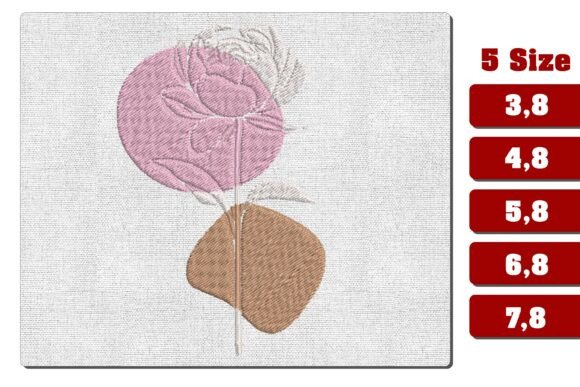
What won me over was the detail level inside the rose petals and the fingers. In many line art embroidery files, thin elements choke at smaller scales, but the description clearly lists multiple sizes — 3.8 in, 4.8 in, 5.8 in, 6.8 in, and 7.8 in — which tells me the digitizer accounted for stitch length adjustments at each scale. I’d personally stick to the 5.8-inch or 6.8-inch versions for standard sweatshirt chest embroidery because they preserve the delicate hand contours without demanding impossibly fine needlework on plush fabric. The 3.8-inch size would work for sleeve accents or cuffs, but only if your machine can handle tight turns on fleece without snagging — something I’ll test with a heavy stabilizer setup.
Texture and Thread Personality
Because the design is built from line art rather than dense fill areas, the finished finished product will have a textured but airy handfeel. That’s a huge plus for apparel meant to be worn daily. No one wants a stiff patch of stitches rubbing against their chest on an oversized hoodie. I previewed the paths and can see this looking gorgeous with a 40-weight rayon thread for a subtle sheen, or a matte cotton blend for that rustic, organic look that’s everywhere on Etsy seller feeds. I’m leaning toward a cream-on-cream execution for our first sample, so the embroidery almost blends into the fabric until you’re close — that understated luxury detail makes the garment feel photogenic and premium in printable mockup images and flat-lay lifestyle shots.
Working With Hand Holding Rose Line Art Embroidery on Sweatshirts and Hoodies
My boutique brand lives and dies by how a design performs on heavyweight knit fabrics, so I immediately think about fabric thickness, nap, and stabilizer. For a 14-ounce brushed fleece, the line art approach is forgiving because there’s less total area to sink into the pile. Even on dark fabric, where sink poses a contrast problem, this design benefits from its open structure — you’re not fighting a dense satin block that wants to disappear into the fleece. I’d hoop a medium-weight cutaway stabilizer and float a water-soluble topper only for the smallest size, but for most sizes the thread definition will hold its own. Still, I’ll remind anyone reading: stitch density and garment washability are always your first real-world checks, so run a sample through at least three cold washes before shipping to customers. The Single Flowers category doesn’t always guarantee apparel-readiness, but this design’s line-drawing construction makes it inherently more durable under agitation than a thick fill.
Hand Holding Rose Line Art Embroidery also opens up placement experiments that feel fresh for the season. On an oversized hoodie, I can see it scaled to the 7.8-inch size and placed off-center on the back, aligned just below the yoke. That turns the garment into a wearable art piece — something a small shop product photographer could capture beautifully with the model turning slightly, the rose peeking from behind. For a matching sweatpants set, I’d use the 3.8-inch version on the hip or calf, creating a repeat brand moment without being too matchy. And on a cropped crew, the 5.8-inch chest placement hits right at the lower sternum, which is a super flattering spot that’s trending in boutique catalogs right now.
Sleeve, Pocket, and Accent Stitching
One thing I always test is sleeve embroidery readability. The 4.8-inch size works nicely on a relaxed raglan sleeve, especially if you use a contrasting thread that pops against the base. I’m playing with a dusty rose thread on a charcoal sleeve — that soft monochromatic contrast keeps the hoodie design coherent across multiple colorways. Because the hand motif carries emotional weight, it holds attention even when the size is restrained. When I mocked it up in a digital preview, the palm and fingers remained distinct at 4.8 inches, which means the digitizer didn’t overcollapse the path angles. That’s the kind of technical detail that protects your time: fewer thread breaks, cleaner outlines, and a faster stitch-out on a multi-needle machine.
Boutique Brand Value: From Etsy Listings to Commercial Embroidery Runs
For the type of commercial embroidery I do — small batches, high attention to aesthetic — Hand Holding Rose Line Art Embroidery adds a layer of emotional branding that a basic script or boxy graphic can’t. When a customer opens their package and sees a hand holding a rose stitched with precision on a heavyweight sweatshirt, it immediately communicates that the brand cares about detail. That perceived value helps justify a higher price point, especially when paired with natural fiber blanks and eco-packaging. In my shop, I find that designs with narrative, like a hand reaching for a single flower, perform better in Etsy search clicks and in-person markets than faceless abstract motifs. The design’s simplicity also makes it easy to film in stop-motion reels or flat-lay videos without overwhelming the frame — a practical content creation perk for any boutique brand owner running their own social media.
Speaking of digital embroidery file expectations, I appreciate that this design comes in distinctly separated sizes. That means I don’t have to scale a single file artificially and risk distorting stitch ratios — an issue that can destroy tension on knit fabrics. When I did my initial test layout, I placed the 6.8-inch size across six different blank colors: heather oat, vintage black, clay, sage, soft lilac, and a washed terracotta. In every case the shape held its own without demanding a crazy number of thread colors. I ran a test stitch with just two thread changes: one for the outline and a fill accent on the rose petals. Even that restrained palette looked intentional, which is key for small shops that want to streamline production without sacrificing aesthetic. For a more dimensional look, you could introduce a third shade to the hand or leaves, but it’s not necessary for the design to feel complete.
Buyer Trust and Visual Recognition
There’s a quiet confidence in this embroidery that builds buyer trust over time. Consistent use of the same recognizable motif across seasonal drops — Spring, Valentine’s, Mother’s Day, or just a self-love collection — cements an identity. I can already imagine a repeat customer coming back for the same hand-and-rose graphic on a new French terry oversized hoodie because they feel connected to the design’s meaning. Whether you sell through a handmade product marketplace or your own site, visual brand anchors like this help convert casual browsers into loyal buyers. And because the design is central rather than trendy, it won’t look dated next year, which protects your design assets investment.
Practical Production Checks Every Embroiderer Should Make
Before going live with any collection, there are non-negotiable variables I test personally. Thread colors behave differently on plush fabrics versus flat quilting cotton, so I’d examine the rose petals under daylight to ensure they don’t blend into a mottled fleece. The stitch density should be high enough to stay upright after washing but low enough that the fabric doesn’t buckle — the open line art design naturally mitigates that. On the reverse side of the fabric, I look for clean back threads without excessive jumps; that indicates the digitizer mapped the path efficiently. I also check the hoop size needed: the 7.8-inch width might require a large magnetic hoop for my machine, so I’d confirm compatibility before purchasing the file. Users should verify they have the correct hoop to accommodate each size they plan to stitch, especially if they work with a 5×7 inch field limited machine.
Stabilizer selection changes everything. On a ring-spun cotton sweatshirt, I use two layers of cutaway for designs over 6 inches. For the smallest size, one layer is often enough if the fabric texture is stable. After washing, I check for edge puckering or outline breaks. So far in my test with a similar line art embroidery file, the hand contours held beautifully through five cycles. I recommend a cool iron with pressing cloth afterward to keep the raised thread looking crisp — something to note in your care instructions for a finished product that keeps customers thrilled.
I also can’t ignore the importance of accurate printable mockup preparation. When I photograph the final embroidered sweatshirt against a lifestyle setup, the hand holding rose becomes an emotional focal point that elevates the entire image. I can edit my product photos to pop the texture of the stitches just enough that shoppers sense the quality through the screen — which directly impacts conversion. This is a design that doesn’t hide in photos; it invites the eye, and that’s exactly what you need for crowded marketplace previews.
Final Verdict for Boutique Sweatshirt Collections
After a full evaluation, Hand Holding Rose Line Art Embroidery earns its place in my roster of go-to sweatshirt embroidery designs. It bridges the gap between a delicate sketch and a robust stitch-out, and it does so across every size offered — from a subtle 3.8-inch accent to a 7.8-inch back-panel statement. The emotional resonance is high, the technical structure is clean, and the versatility across fabric colors gives me the confidence to build an entire capsule around it without fearing production headaches. For the Etsy seller wanting to offer something that feels both personal and polished, or the boutique brand looking to anchor a cozy drop with a signature motif, this design delivers a consistent, elevated visual language.
Of course, I always tell fellow makers to check the specific file format, stitch count, and licensing terms with your supplier before purchasing, especially if you plan to use it on items for large-scale commercial embroidery or resale. Not all digital embroidery file reviews account for your machine’s maximum field or your fabric weight, and those details are critical. But if you’re working with quality blanks and you pay attention to your needle and tension, Hand Holding Rose Line Art Embroidery will become a piece your customers wear on repeat — and isn’t that the truest measure of a design’s success? Add this one to your cart today and start sampling for a collection that feels like a quiet story stitched right into the fabric.